Swing Gate or Rolling Gate: Planning a Driveway Gate in Yakima
The right gate depends less on taste than on space, slope, and how often you'll use it.
October 8, 2026 · 3 min read
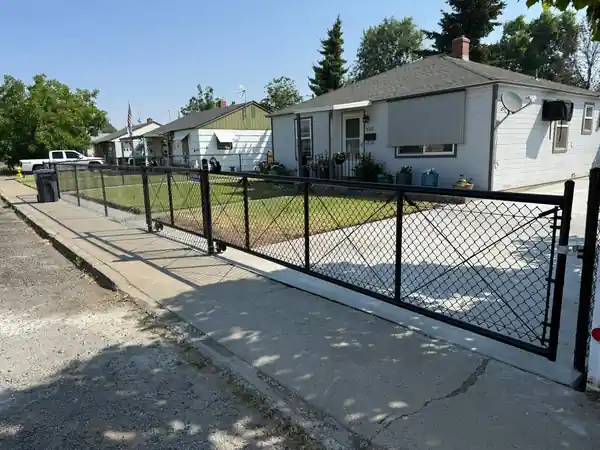
Most gate trouble starts at planning, not installation. A gate that's too narrow scrapes mirrors. A gate that swings the wrong way hits a slope. A heavy gate on light posts sags within a year. L S Fencing builds custom gates and gate operators for homes and businesses, and a few basic questions settle most of it.
Swing gates: simple and familiar
A swing gate hinges on one side and opens like a door. It's the simplest design, with the fewest moving parts, and it works well on level ground where there's room to open.
Two things limit it. First, it needs a clear arc. Whatever the gate sweeps through, such as gravel, a parked car, a woodpile, or a rising driveway, has to stay clear. Second, a wide opening usually means a pair of gates meeting in the middle instead of one very long leaf. A single wide leaf is heavy, and weight is what makes gates sag.
Rolling cantilever gates: they slide, not swing
A rolling cantilever gate slides sideways along the fence line, riding on rollers mounted in its support posts. It doesn't touch the ground, so there's no track to fill with gravel, mud, or ice.
The catch is space. A cantilever gate needs a length of straight fence beside the opening that's at least as long as the opening itself, and usually more because of its counterbalance section. If the fence turns a corner or meets a building right next to the opening, a rolling gate may not fit. Walk the fence line on both sides of the opening and look for trees, utility poles, and grade changes before you fall in love with the idea.
Rolling gates are a good answer for sloped or uneven driveways, where a swing gate would drag, and for tight spaces where you can't give up the swing area.
Choosing a width
Measure the widest thing you'll ever bring through, not the thing you bring through most days. Then add margin.
- Walk gates are commonly 3 to 4 feet wide, enough for a wheelbarrow or a person with a load.
- A single vehicle gate is commonly around 10 to 12 feet, enough for a pickup with mirrors.
- Trailers, RVs, and equipment can call for 14 feet or more, usually in a double gate or a rolling gate.
- Garden tractors and mowers can often get by with a narrower drive opening, but measure the actual machine.
Leave a foot or so of clearance on each side of the widest vehicle. Backing a trailer into an opening exactly as wide as the trailer is a daily frustration.
Gate posts do the heavy lifting
A gate hangs its full weight from a post, and a chain link gate with fabric, frame, and hardware is heavier than it looks. Gate posts are larger than line posts and set deeper in concrete, because the post is under a constant sideways pull. Skimping on a gate post is how a gate ends up dragging on the ground a season later. The same goes for the latch post on a double gate, where two leaves meet and any lean in either post leaves a gap.
A Google review of L S Fencing puts it plainly: "Always have been able to help with our gate problems in a timely, orderly, and professional fashion." Gate problems are common enough that fixing them is part of the work.
When a gate operator makes sense
A gate operator is a motor that opens and closes the gate for you. It's worth considering when:
- The gate is heavy, like a long rolling gate or a pair of wide swing gates.
- You use it many times a day and don't want to leave the truck.
- The driveway is on a road where stopping to open a gate is awkward.
- A family member has trouble pushing or pulling a gate by hand.
An operator needs power, either from a nearby circuit or a solar setup, and it needs safety devices so the gate doesn't close on a person or a vehicle. Ask your installer what protections come with the operator and how to open the gate by hand if the power goes out.
Before anyone digs
Gate posts go deep. Call 811 a few days before digging so underground lines are marked, and check with your city or county about any permit or rules for gates and fences. L S Fencing has been in Yakima since 1974. Call (509) 452-3000 to talk through a gate, or walk into the yard at 1711 Swier Lane, Monday through Thursday, 8 to 4.
L S Fencing, (509) 452-3000
Call (509) 452-3000More articles
Privacy Slats on Chain Link: When They Make Sense in the Yakima Valley
Slats turn an open chain link fence into a screen, and they come with trade-offs worth knowing before you order.
Galvanized or Black Vinyl Chain Link for a Front Yard
Both fences keep a yard contained, but they look and wear differently once they're standing in front of your house.